pop up description layer
HOME
Cryptozoology UFO Mysteries Aviation Space & Time Dinosaurs Geology Archaeology Exploration 7 Wonders Surprising Science Troubled History Library Laboratory Attic Theater Store Index/Site Map Cyclorama
Search the Site:
|



|
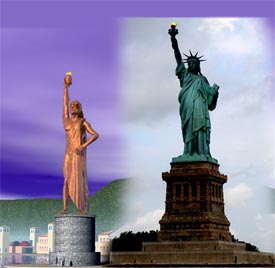
Travelers to the New York City harbor see a marvelous sight. Standing on a small island in the harbor is an immense statue of a robed woman, holding a book and lifting a torch to the sky. The statue measures almost one-hundred and twenty feet from foot to crown. It is sometimes referred to as the "Modern Colossus," but more often called the Statue of Liberty. This awe-inspiring statue was a gift from France to America and is easily recognized by people around the world. What many visitors to this shrine to freedom don't know is that the statue, the "Modern Colossus," is the echo of another statue, the original colossus, that stood over two thousand years ago at the entrance to another busy harbor on the Island of Rhodes. Like the Statue of Liberty, this colossus was also built as a celebration of freedom. This amazing statue, standing the same height from toe to head as the modern colossus, was one of the Seven Wonders of the Ancient World. The Island of Rhodes The island of Rhodes was an important economic center in the ancient world. It is located off the southwestern tip of Asia Minor where the Aegean Sea meets the Mediterranean. The capitol city, also named Rhodes, was built in 408 B.C. and was designed to take advantage of the island's best natural harbor on the northern coast.
In 357 B.C. the island was conquered by Mausolus of Halicarnassus (whose tomb is one of the other Seven Wonders of the Ancient World) but fell into Persian hands in 340 BC and was finally captured by Alexander the Great in 332 BC. When Alexander died of a fever at an early age, his generals fought bitterly among themselves for control of Alexander's vast kingdom. Three of them, Ptolemy, Seleucus, and Antigous, succeeded in dividing the kingdom among themselves. The Rhodians supported Ptolemy (who wound up ruling Egypt) in this struggle. This angered Antigous who in 305 BC sent his son Demetrius to capture and punish the city of Rhodes. The War with Demetrius The war was long and painful. Demetrius brought an army of 40,000 men. This was more than the entire population of Rhodes. He also augmented his force by using Aegean pirates.
The city was protected by a strong, tall wall and the attackers were forced to use siege towers to try and climb over it. Siege towers were wooden structures that could be moved up to a defender's walls to allow the attackers to climb over them. While some were designed to be rolled up on land, Demetrius used a giant tower mounted on top of six ships lashed together to make his attack. This tower, though, was turned over and smashed when a storm suddenly approached, causing the battle to be won by the Rhodians. Demetrius had a second super tower built and called it the Helepolis which translates to "Taker of Cities." This massive structure stood almost 150 feet high and some 75 feet square at the base and weight 160 tons. It was equipped with many catapults and skinned with wood and leather to protect the troops inside from archers. It even carried water tanks that could be used to fight fires started by flaming arrows. This tower was mounted on iron wheels and it could be rolled up to the walls under the power of 200 soldiers turning a large capstan. When Demetrius attacked the city, the defenders stopped the war machine by flooding a ditch outside the walls and miring the heavy monster in the mud. By then almost a year had gone by and a fleet of ships from Egypt arrived to assist Rhodes. Demetrius withdrew quickly, leaving the great siege tower where it was. He signed a peace treaty and called his siege a victory as Rhodes agreed to remain neutral in his war against Ptolemy. Statue Commemorates Victory
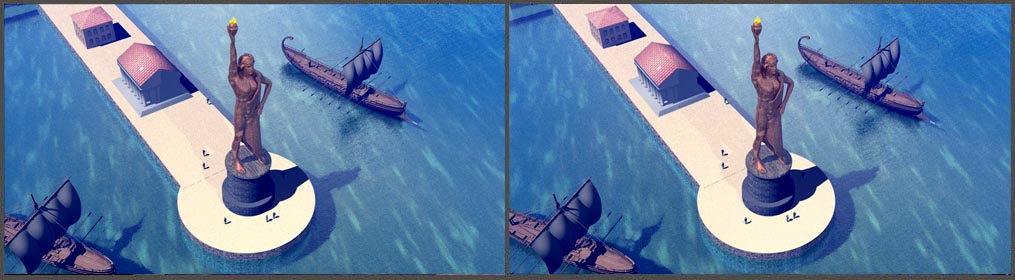
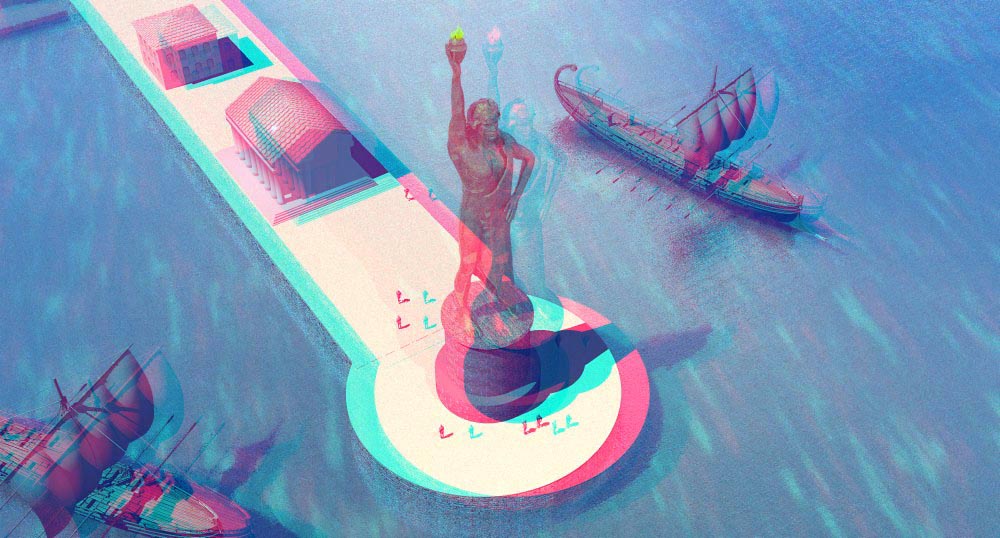
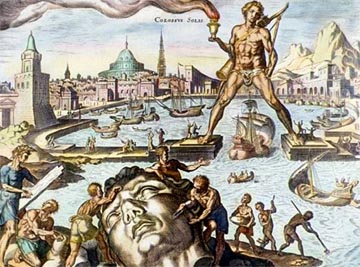
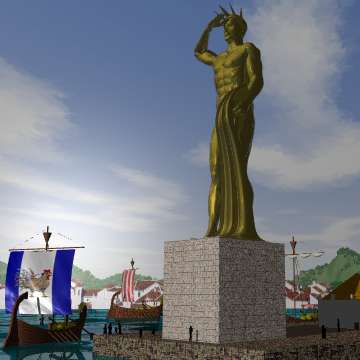
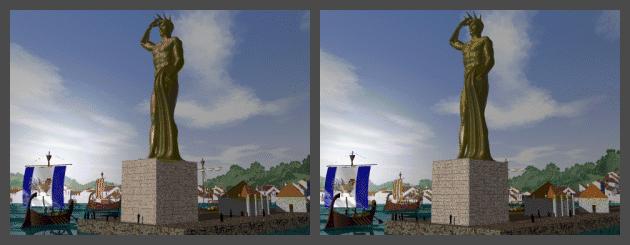
The people of Rhodes saw the end of conflict differently, however. To celebrate their victory and freedom, the people of Rhodes decided to build a giant statue of their patron god Helios. They melted down bronze from the many war machines Demetrius left behind for the exterior of the figure and the super siege tower became the scaffolding for the project. Although some reportedly place the start of construction as early as 304 BC it is more likely the work started in 292 BC. According to Pliny, a historian who lived several centuries after the Colossus was built, construction took 12 years. The statue was one hundred and ten feet high and stood upon a fifty-foot pedestal near the harbor entrance perhaps on a breakwater. Although the statue has sometimes been popularly depicted with its legs spanning the harbor entrance so that ships could pass beneath, it was actually posed in a more traditional Greek manner. Historians believe the figure was nude or semi-nude with a cloak over its left arm or shoulder. Some think it was wearing a spiked crown, shading its eyes from the rising sun with its right hand, or possibly using that hand to hold a torch aloft in a pose similar to one later given to the Statue of Liberty. No ancient account mentions the harbor-spanning pose and it seems unlikely the Greeks would have depicted one of their gods in such an awkward manner. In addition, such a pose would mean shutting down the harbor during the construction, something not economically feasible. When the statue was finished it was dedicated with a poem: To you, o Sun, the people of Dorian Rhodes set up this bronze statue reaching to Olympus, when they had pacified the waves of war and crowned their city with the spoils taken from the enemy. Not only over the seas but also on land did they kindle the lovely torch of freedom and independence. For to the descendants of Herakles belongs dominion over sea and land.
Engineering the Statue The statue was constructed of bronze plates over an iron framework (very similar to the Statue of Liberty which is copper over a steel frame). According to the book of Pilon of Byzantium, 15 tons of bronze were used and 9 tons of iron, though these numbers seem low to modern architects. The Statue of Liberty, roughly of the same size, weighs 225 tons. The Colossus, which relied on weaker materials, must have weighed at least as much and probably more. Ancient accounts tell us that inside the statue were several stone columns which acted as the main support. Iron beams were driven into the stone and connected with the bronze outer skin. Each bronze plate had to be carefully cast then hammered into the right shape for its location in the figure, then hoisted into position and riveted to the surrounding plates and the iron frame. Some stories say that a massive earthen ramp was used to access the statue during construction. Modern engineers, however, calculate that such a ramp running all the way to the top of the statue would have been too massive to be practical. This lends credence to stories that the wood from the Helepolis seige engine was reused to build a scaffolding around the statue while it was being assembled. The architect of this great construction was
Chares of Lindos, a Rhodian sculptor who was a patriot and fought
in defense of the city. Chares had been involved with large scale
statues before. His teacher, Lysippus, had constructed a 60-foot
high likeness of Zeus. Chares probably started by making smaller
versions of the statue, maybe three feet high, then used these
as a guide to shaping each of the bronze plates of the skin.
It is believed Chares did not live to see his project finished. There are several legends that he committed suicide. In one tale he has almost finished the statue when someone points out a small flaw in the construction. The sculptor is so ashamed of it he kills himself.
In another version the city fathers decide to double the height of the statue. Chares only doubles his fee, forgetting that doubling the height will mean an eightfold increase in the amount of materials needed. This drives him into bankruptcy and suicide. There is no evidence that either of these tales is true, however. Collapse of the Colossus The Colossus stood proudly at the harbor entrance for some fifty-six years. Each morning the sun must have caught its polished bronze surface and made the god's figure shine. Then an earthquake hit Rhodes in 226 BC and the statue collapsed. Huge pieces of the figure lay along the harbor for centuries. A computer simulation suggests that the shaking of the earthquake made the rivets holding the bronze plates together break. At first only a few weak ones gave way, but when they failed the remaining stress was transferred to the surviving rivets, which then also failed in with a cascading effect. Though some accounts related that the statue fell over and broke apart when it hit the ground, it is more likely pieces, starting with the arms, dropped away. The legs and ankles might have even remained in position following the quake. "Even as it lies," wrote Pliny, "it excites our wonder and admiration. Few men can clasp the thumb in their arms, and its fingers are larger than most statues. Where the limbs are broken asunder, vast caverns are seen yawning in the interior. Within it, too, are to be seen large masses of rock, by the weight of which the artist steadied it while erecting it." It is said that the Egyptian king, Ptolemy III, offered to pay for its reconstruction, but the people of Rhodes refused his help. They had consulted the oracle of Delphi and feared that somehow the statue had offended the god Helios, who used the earthquake to throw it down. In the seventh century A.D., the Arabs conquered Rhodes and broke the remains of the Colossus up into smaller pieces and sold it as scrap metal. Legend says it took 900 camels to carry away the pieces. A sad end for what must have been a majestic work of art.
Copyright Lee Krystek 2011. All Rights Reserved. |


|
Related Links |
|
|