|
|
|
x
|
A
Gallery of Geyser Feild Formations (Part II)
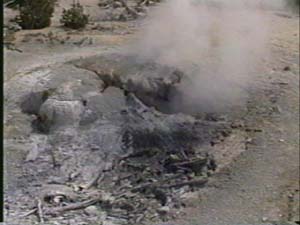 Fumarole
- A hot spring that boils off all its water before the
water reaches the surface is called a fumarole,
or steam vent. Small amounts of hydrogen sulfide often
gives the steam a "rotten egg" smell. Fumarole
- A hot spring that boils off all its water before the
water reaches the surface is called a fumarole,
or steam vent. Small amounts of hydrogen sulfide often
gives the steam a "rotten egg" smell. |
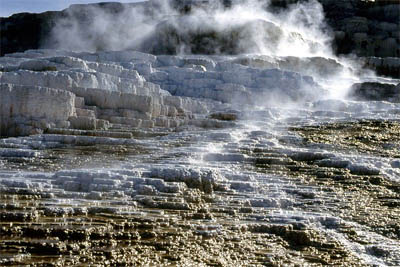 Terraced
Hot Spring - These springs on a hill at Mammoth
Hot Springs in Yellowstone National Park have created
a series of terraces because of calcium carbonate that
was dissolved into the water while it was hot and deposited
as the liquid cooled at the edge of the spring. The
high level calcium makes it impossible for most vegetation
to live on the terraces.- (Photo by Tasma3197
licensed under the Creative Commons Attribution 3.0
Unported license.) Terraced
Hot Spring - These springs on a hill at Mammoth
Hot Springs in Yellowstone National Park have created
a series of terraces because of calcium carbonate that
was dissolved into the water while it was hot and deposited
as the liquid cooled at the edge of the spring. The
high level calcium makes it impossible for most vegetation
to live on the terraces.- (Photo by Tasma3197
licensed under the Creative Commons Attribution 3.0
Unported license.) |
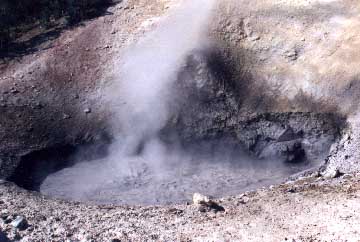 Mud
Pot - If a fumarole emerges under surface water
the hydrogen sulfide in the steam is oxidized in the
water both by chemical reactions and bacteria to make
sulfuric acid. The sulfuric acid dissolves the nearby
rock making wet, muddy clay. As the steam bursts through
the clay, the bubbling action of the mud pot is created.
Depending on the amount of surface water available,
mud pots can change in consistency with the season.
This picture is of the Mud Volcano at Yellowstone National
Park. Though less active in recent years it was known
to throw mud a hundred feet in the 19th century. Mud
Pot - If a fumarole emerges under surface water
the hydrogen sulfide in the steam is oxidized in the
water both by chemical reactions and bacteria to make
sulfuric acid. The sulfuric acid dissolves the nearby
rock making wet, muddy clay. As the steam bursts through
the clay, the bubbling action of the mud pot is created.
Depending on the amount of surface water available,
mud pots can change in consistency with the season.
This picture is of the Mud Volcano at Yellowstone National
Park. Though less active in recent years it was known
to throw mud a hundred feet in the 19th century. |
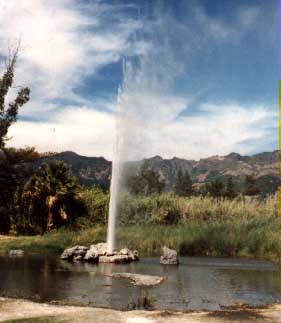 Old
Faithful of the Napa Valley - Not all geysers are
in Yellowstone. This geyser is located in Northern California
in the Napa Valley near Calistoga. It erupts on an average
of every 30 minutes for about 3 to 4 minutes, shooting
a stream of water about 60 feet into the air. The geyser
is not on public land, but is a privately-held tourist
attraction. Old
Faithful of the Napa Valley - Not all geysers are
in Yellowstone. This geyser is located in Northern California
in the Napa Valley near Calistoga. It erupts on an average
of every 30 minutes for about 3 to 4 minutes, shooting
a stream of water about 60 feet into the air. The geyser
is not on public land, but is a privately-held tourist
attraction. |
 Old
Faithful of the Napa Valley's Unfortunate Companion
- This hot spring was capped in the 1800's to provide
hot water to heat a house. Around the world geysers
are in danger of disappearing due to vandalism and an
increase of geothermal power plants. People throwing
objects into a geyser can block its plumbing, killing
it. Geothermal power plants built too close to geysers
can steal their water supply, starving them. We need
to plan for the protection of geysers if we want future
generations to enjoy them. Old
Faithful of the Napa Valley's Unfortunate Companion
- This hot spring was capped in the 1800's to provide
hot water to heat a house. Around the world geysers
are in danger of disappearing due to vandalism and an
increase of geothermal power plants. People throwing
objects into a geyser can block its plumbing, killing
it. Geothermal power plants built too close to geysers
can steal their water supply, starving them. We need
to plan for the protection of geysers if we want future
generations to enjoy them. |
Return to Gallery of Geysers Part
I

Copyright
Lee Krystek 2001-12. All Rights Reserved.
|
|
|
|