The most famous picture of the Loch
Ness Monster, a grainy black and white photograph showing
a long head and neck emerging from the lake, turned out to be
a hoax.
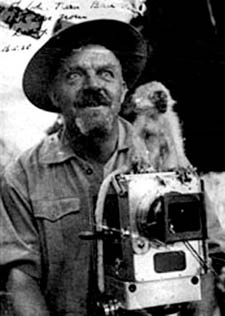
In 1993, Christian Spurling, stepson of the flamboyant
movie maker and big game hunter "Duke" Wetherell, admitted he'd
made the "monster" out of some plastic and a clockwork, tinplate,
toy submarine. The picture (Often referred to as the "Surgeon's
Photograph," because Colonel Robert Kenneth Wilson, a physician,
claimed to had taken it by the Loch in April of 1934) had withstood
careful scientific examination. Monster fans had speculated
that the pictures showed a plesiosaur, while skeptics said it
must have been an otter head or tree trunk. Nobody seems to
have suspected it was actually a toy submarine.
Marmaduke
Wetherell
Tracking
Down the Story
According to two Loch Ness researchers, David
Martin and Alastair Boyd, in 1993 they'd heard Wetherell's son,
Ian, in a 1975 article, had alleged that his father had faked
one of the "Nessie" photographs. A couple of things seem to
ring true about his statement. First he named Maurice Chambers
as a part of the conspiracy. This was the very man Wilson had
said he was going to visit the day he took photo. Also Ian Wetherell
had mentioned that some of the photos taken that had been included
the far shoreline in the image.
Since, with only one exception, every version
of the published pictures had the shoreline cropped out, it
seemed likely that Ian only knew about it because he'd been
there when the photo was taken. Since by then Ian Wetherell
was dead, the two men decided to talk to Ian's stepbrother,
Christian Spurling. When Martin and Boyd visited him, Spurling,
then 93, admitted he'd been approached by Duke Wetherell to
build a fake monster.
Duke Wetherell apparently concocted the plan as
revenge upon the London Daily Mail newspaper. In 1933
the Daily Mail had hired Wetherell to find the Loch Ness Monster.
Soon after arriving at the lake Wetherell found some strange
tracks of a four-toed creature in the soft mud near the water.
Wetherell estimated that whatever left the tracks must be twenty
feet in length. Plaster casts were taken and sent to the London
Museum of Natural History. While the world awaited the Museum's
analysis, however, hundreds of monster hunters and tourists
showed up at the Loch. Unfortunately after a few weeks the Museum
announced that the tracks were not that of an unknown monster,
but those of a hippo. Apparently Wetherell himself had been
hoaxed. The dried foot used to make the print was probably part
of an umbrella stand or ash tray. The Daily Mail was angered
at Wetherell and ridiculed and humiliated him.
Spurling
constructed a fake monster out of a tinplate toy submarine
and plastic material.(Copyright Lee
Krystek, 2011)
Wetherell's
Revenge
It was soon after this that Spurling, who was
a model-maker by trade, was approached by his stepfather to
build the "beast." Construction was done with plastic wood over
the conning tower of the toy submarine he'd purchased. The neck,
estimated by some from the photograph to be over three feet
high, actually measured between 8 and 12 inches.
"We'll give them their monster," Duke told his
son. Ian Wetherell and his father took the completed contraption
and a camera to the Loch and photographed it on a quiet bay,
then sank the evidence in the mud at the edge of the lake. The
undeveloped film was then passed to Chambers and on to Colonel
Wilson, who had them developed. He then sold them photo to the
Daily Mail. The conspirators were quite unprepared for the publicity
the photo generated and apparently decided not to admit the
hoax. The story stayed unknown for over sixty years.
Video:
The Man Who Made the Loch Ness Monster
Not everyone thinks that the photo is a fake.
Some have questioned why Martin and Boyd waited to announce
the story until Spurling was dead, making it impossible for
others to question him. As far as the beast itself goes, not
even Boyd thinks that the end of the Surgeon's photo is the
end of the Loch Ness Monster. Boyd, who has seen the creature
himself, remains a believer.
Copyright Lee Krystek 1996-2011.
All Rights Reserved.