Venus in the
Corner Pocket
Venus in the
Corner Pocket
The Controversial Theories of Immanuel
Velikovsky
In 1950 a Russian-born psychiatrist named Immanuel
Velikovsky authored a controversial book. Velikovsky was extremely
knowledgeable in the texts of ancient peoples. Based on his interpretation
of these texts, Velikovsky reached the conclusion that our solar
system, with its nine planets, was not always the same as we see
it today.
The book, Worlds in Collision, asserted that
around 3,500 years ago the planet Venus was somehow ejected from
the planet Jupiter as a comet. Comet Venus then started wandering
through the solar system. Its gravitational field pushed other
planets out of their orbits or changed their rotation.
Velikovsky attributed many of the disasters recorded
in ancient times to this strange interaction the Earth had with
Venus. Material that fell from Venus's comet tail into Earth's
atmosphere caused the plagues visited upon Egypt as recorded in
the Bible. "Plague is throughout the land. Blood is everywhere,"
cried the Egyptian Ipuwer. "Men shrink from tasting, human beings
thirst after water..." According to Velikovsky's thinking, a fine
rusty ferruginous dust from the comet's tail filtered down on
the globe turning everything red.
As Earth went deeper into the comet's tail the dust
turned to small stones and a hail of gravel pelted the Earth:
"...there was hail, and fire mingled in with hail, very grievous,
such as there was none like it in all the land of Egypt since
it became a nation," the Bible reads.
Velikovsky also credits the manna that nourished
the nation of Israel during their forty-year wandering through
the desert in Exodus to carbohydrates that fell to Earth from
comet Venus's tail.
As Venus grew closer, the gravity of the planet
caused the Earth to rock on its axis or stop and start its rotation.
Earthquakes broke out and vital waves engulfed mountain ranges.
Velikovsky speculates that this maybe when the legendary city
of Atlantis sunk beneath the waves.
The changes in rotation, according to Velikovsky,
caused a prolonged darkness over the Earth. His research discovered
that in Iran scholars recorded a night lasting three days followed
by a day lasting three days. The Chinese recorded the same phenomena.
The Bible speaks of a day when the sun stood still to allow Joshua
to finish a battle.
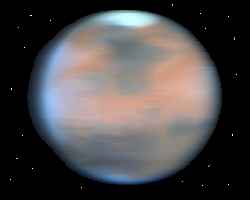 According
to Velikovsky's work ,somewhere in the eighth century B.C., the
Venus comet pushed Mars out of its proper orbit and into a close
encounter with Earth. This caused earthquakes to shake the world:
"Both the poles shook," wrote one observer at around 747 B.C.
"and Atlas (who according to legend carried the Earth on his back)
shifted the burden of the sky...The sun vanished and rising clouds
obscured the heavens..." The year shortened and ancient astrologers
were forced to develop a new calender.
According
to Velikovsky's work ,somewhere in the eighth century B.C., the
Venus comet pushed Mars out of its proper orbit and into a close
encounter with Earth. This caused earthquakes to shake the world:
"Both the poles shook," wrote one observer at around 747 B.C.
"and Atlas (who according to legend carried the Earth on his back)
shifted the burden of the sky...The sun vanished and rising clouds
obscured the heavens..." The year shortened and ancient astrologers
were forced to develop a new calender.
Finally, after many years of causing catastrophes
on Earth, Venus and Mars settled into their current near-circular
orbits.
Velikovsky's theories didn't fit in at all with
modern astrophysics and he was criticized by most scientists.
They saw his work as just another crackpot theory. And they had
quite a bit of evidence to refute it.
A few scientists weren't satisfied to duke it out
with Velikovsky in the marketplace of ideas, though. They made
the blunder of putting pressure on Velikovsky's publisher not
to publish "Worlds in Collision" as a part of the company's textbook
series.
When this became known, public sympathy shifted
toward Velikovsky, increasing his popularity. He was a persuasive
author and many began to believe in his theories. Isaac Asimov,
a Velikovsky critic (and not a bad wordsmith himself) once wrote:
"He is an interesting writer. It's fun to read his books. I have
read every book he has published and hope to read any he writes
in the future. Although he doesn't lure me into accepting his
views, I can well see where those less knowledgeable in the fields
Velikovsky deals with would succumb."
So what makes scientists doubt Velikovsky's views?
They have a long list of reasons why such a scenerio was not possible.
A few of the more important ones are:
The temperature of Venus. Actually, both sides in
this controversy point to this as evidence for their claims. When
Velikovsky first published his ideas the temperature on the surface
of Venus was not known. As Frank Drake of the National Radio Astronomy
Observatory wrote, "We would have expected a temperature of only
slightly greater than that of Earth..." Velikovsky had predicted
Venus, after its close encounter with Earth, Mars and the Sun,
would have a much higher than expected temperature. Indeed it
was discovered that the surface temperature was 750 degrees Kelvin.
Hot enough to melt lead.
Carl Sagan, one of Velikovsky's most ardent
critics, argued that if Venus had been ejected out of Jupiter,
the required amount of energy would have heated Venus so much
the planet/comet would have vaporized. And even if somehow the
planet had managed to survive the ejection the temperature, even
thousands of years later, claimed Sagan, would have been much
greater than those found today.
Sagan also argued that if Venus had been on an extremely
eccentric orbit as Velikovsky suggests, it would be highly unlikely
that it could have changed its orbit so radically in the few thousand
years to the nearly circular orbit that the planet enjoys today.
Velikovsky didn't seem to be concerned with the
problems his theory generated for physicists. He himself said,
"the ancient traditions are our best guide to the appearance and
arrangement of the earliest remembered solar system, not some
fancy computer's retrocalculations based upon current understanding
of astronomical principles."
However, other scientific disciplines don't seem
to bear out Velikovsky's ideas, either. Geologists who have cored
into the world's icepacks and ocean bottoms have not found signs
of the deposits Venus made upon Earth as the Earth passed through
the planet/comet's tail (In fact Venus is much too massive with
too strong a gravity to ever have had a visible tail as Velikovsky
claims).
Venusian geology doesn't seem to support a young
Venus, either. Radar studies of the planet's surface show a landscape
saturated with craters. The overlapping edges of these craters
show they are impact craters instead of volcanic. The high number
of them show that the Venusian surface is very old. There are
just too many of them to have accumulated in just the past 3,500
years.
 Even
in the realm of anthropology there seems to be problems with the
Velikovsky theories. According to Worlds in Collision Venus
did not exist before about 1,500 B.C.. In his book Velikovsky
says that neither the Hindus or the Babylonians recorded the planet
Venus. However Peter Huber, from the Edgennossische Technische
Hochschule, Zurich, reports that in Cuneiform texts stetching
as far back as 3,000 B.C., Venus is mentioned as the star connected
with the rising and setting sun. Clear evidence that it occupied
an orbit in between the Earth and the sun as it does today. Also
in records from 1580 to 1560 B.C. observations were made of Venus
that clearly puts it in an orbit identical with the planet's current
orbit.
Even
in the realm of anthropology there seems to be problems with the
Velikovsky theories. According to Worlds in Collision Venus
did not exist before about 1,500 B.C.. In his book Velikovsky
says that neither the Hindus or the Babylonians recorded the planet
Venus. However Peter Huber, from the Edgennossische Technische
Hochschule, Zurich, reports that in Cuneiform texts stetching
as far back as 3,000 B.C., Venus is mentioned as the star connected
with the rising and setting sun. Clear evidence that it occupied
an orbit in between the Earth and the sun as it does today. Also
in records from 1580 to 1560 B.C. observations were made of Venus
that clearly puts it in an orbit identical with the planet's current
orbit.
So are Velikovsky's ideas that events in the solar
system might affect life on Earth worthless? No, not at all. While
Velikovsky is apparently wrong about a Venus that wanders through
the solar system in historical times, he may have in some small
way stimulated scientific thinking on the stability of the solar
system. Isaac Asimov, who referred to Velikovsky's theories as
a type of "exoheresy" wrote: "For one thing Velikfovskianism,
and indeed, any exoheretical view that becomes prominent enough
to force itself on science, acts to puncture scientific complacency-and
that is good. An exoheresy may cause scientists to bestir themselves
for the purpose of reexamining the bases of their beliefs, even
if only to gather firm and logical reasons for the rejection of
the exoheresy-and that is good too. An exoheresy may cause scientific
activity which, in a serendipitous fashion, may uncover something
worthwhile that has nothing to do with the exoheresy-and that
is very good, if it happens."
When Velikovsky first wrote Worlds in Collision,
many scientists rejected it not only because of reasoned arguments,
but because the idea that the solar system could change or that
events in space could have a profound effect on life on Earth
was unsettling. Since that time science has accepted that asteroid
impacts have led to massive extinctions on Earth (just ask the
dinosaurs).
Even the orbits of the planets no longer seem set
in stone. In an article in the September 1999 edition of Scientific
American, Renu Malhotra makes a case that the planets
Saturn, Uranus and Neptune may have expanded their orbits since
the beginning of the solar system, while Jupiter's orbit has shrunk.
He also argues that interactions between Neptune and the planet
Pluto have caused the smaller planet to shift from a near circular
orbit to a more eccentric one that is on a plane inclined from
the rest of the planets.
Will we one day find evidence of events in the
solar system that might explain what Velikovsky observed in some
ancient texts? Perhaps so. But if we are to take any explanation
seriously, we must bring the full weight of several scientific
disciplines like anthropology, physics and geology, to bear the
problem and get their results to agree.
Want to read this article in Belorussian? Click
Here.
Want to red this article in Polish? Click
here.

Copyright Lee
Krystek 1999. All Rights Reserved.